Monday, 15 April 2013

Editing

In this post I am gong to be talking about the editing process of an opening scene. I will compare two film clips and look at how they are edited and the pace of the edit and discuss how I would apply these techniques in my opening scene. The first scene I am going to study is from  the hit 2005 film 'Mr And Mrs Smith'.


In the first 2 minutes we see a couple, Brad Pitt and Angelina Jolie in marriage counselling. The audience can see from the mis en scene that they are a couple on the verge of breaking up by the framing of the shot. Its almost as if they want to keep as far away from each other as possible by sitting right on the edge of there seat and stuffing pillows next to them to as if they are trying to block each other out of their mind. Seeing as they are struggling with the relationship they have cleverly edited the scene making it very slow as if its dragging, reflecting their relationship. Whenever they have nothing too say it cuts to black and the titles come in to place and even makes the audience feel awkward. So overall the way they have edited is in a slow way.

    The next scene I will discuss is the scene from 'The Break Up'. I previously analysed this particular scene in another post a post on this particular scene. In this scene we see a couple breaking up and in comparison to the scene from 'Mr And Mrs Smith' the edit is much faster and less awkward, but more tense for the audience. For my opening scene I would like our pace of editing to be in the middle of the style of these two clips so that it will create an awkward and tense for the audience instead of just being one of the two.


Opening scene in '10 Things I Hate About You' - Analysis


                Analysis of the opening scene in '10 Things I Hate About You'


I analysed the first 2 minutes of the opening scene of 10 things I hate about you. The scene starts off with non diegetic music playing in the background with the song 'One Week' by 'The Barenaked Ladies' . From this we know that it is going to be a film directed at a teenage/young adult audience seeing as this band was very big with teenagers and young people at that specific time. Another reason we can tell that it is a teen film is because the credits are in a graffiti font which would be stereotypical to teenagers seeing as most people, if they were to see graffiti in the street, they would assume a teenager has done it.

We then see an establishing shot of the city and then turns around to show the road with kids on their way to school. A car with the roof down pulls up with four blonde 'Barbie girls' dancing to the song. This shows that the non diegetic music has turned into diegetic music playing on the radio. Their facial expressions show that they are happy and having a good time and do not care if other people can see what they are doing. Their costumes show them to be typical pretty girls with blonde long hair, lipstick and eye-liner and girly t-shirts with flowers printed on them and this also shows that they are the popular ones of the school. They have their hair in bunches so it shows they have put time and effort into their hair.


A rusty old looking orange car pulls up next to them, driven by a girl wearing a leather jacket and her hair tied back with no make up.  This shows that she is very laid back about the way she looks and doesn't want to be classed as a pretty girl. You can also tell this because the song switches to her radio and the song playing is 'Bad Reputation' by' Joan Jett and the Black-hearts .If you listen to the lyrics of the song its saying how she doesn't give a damn about her bad reputation. This song has been included to reflect her personality. The roof of her car is closed. this can represent that she is a closed up and shy.

Facial expressions shows that she doesn't like the girls in the car next to her and even gets annoyed at just looking at them, we see a close up of her face which shows her turning away with an uninterested expression. This is also the case for the girls in the other car with their facial expressions showing that they also do not like her with a medium close up to ensure that they get all of the girls in the shot. You can also see the two girls in the back are leaning out from their normal seating position to ensure that they are in the shot.


We then see an establishing shot of the school to show this is the main setting and location of the film.


I analysed this scene because I knew it was a rom-com and had a target audience similar to mine. Mine will be aimed at teenagers and above and the character is set on a young 20 year old man whereas, this film revolves around teenagers at school and mine revolves around a working man. One thing I did like about the video was the font. i would like to make my font not as graffiti-like as the font in the video but still have it in a cartoony style.

Codes and Conventions of Romantic Comedies


Romantic comedies will sometimes consist of a 'boy meets girl' scenario and the story will contain  a lot of high emotions such as the protagonist falling in love or getting their heart broken after losing someone they love. Some films use a voice-over to introduce the narrative. An example of a film which uses this technique is 'Love Actually'. Some of the props which are used are, wedding bells, flowers, roses which all symbolize love and relationships. The genre is commonly targeted at  female audience because this subject traditionally connects to them more then it does with men. Typically, at the end of every romantic 'fairy tale' there's a 'happy ever after' and there are also hints throughout the film that there will be a happy ending. The codes and conventions in the opening scene of a romantic comedy will be introducing the audience to the protagonist and their current situation, that meaning where they are with their love life e.g. breaking up/getting married and also if they are high class middle or low class. The codes and conventions which I am going to be using in my opening scene will be introducing the audience to the protagonist Kevin and showing us his current situation in his love life which, sadly, is breaking up with his girlfriend again and again over the years.


 Todorov's Narrative Theory

Todorov suggested that there are five stages to a conventional narrative:

1. A stage of equilibrium at the start. (Things are stable and balanced in the lives of the characters.)

2.A disruption of the equilibrium by some action or conflict. (Something happens which throws things out of balance.)

3. Theres a recognition that there has been a disruption. ( The characters realize something is wrong and they need to take action to fix it.)

4. There is an attempt to restore the disruption. (the characters take action to fix what has gone wrong.)

5. Equilibrium is reinstated. (The problem is fixed and the balance is returned to the characters lives.)

With the genre I am studying, rom-coms, Todorov's theory can be applied to most of the films in this genre. A rom-com that follows this theory would be '50 first dates'. it starts off with stage one of Todorov's theory.

1. Henry (Adam Sandler) meets Lucy Whitemoore (Drew Barrymore)  an art teacher in a cafe one morning and they really hit it off and agree to meet up in the cafe the next morning. (equilibrium at the start).

2. The next day they meet each other in the same cafe and Lucy doesn't recall ever meeting Henry and then the cafe owner pulls Henry aside and explains that she suffers from anterograde amnesia (memory loss) as a result of a car accident a year earlier. She believes every day to be October 13, 2002 and her father and brother try to re-enact the activities of October 13, her dads birthday in order to make sure she doesn't learn about her accident. (Disruption of the equilibrium by some action or event.)

3. Henry realizes that he is falling in love with Lucy and he begins to make new ways of meeting Lucy in the cafe every day hoping that one day she will regain her memories and come to terms with her feelings for Henry.  Henry and Lucy's family cant go on as if nothing has happened and decide to leave video tapes explaining what has happened and explaining about the accident and Henry. They go on lots of dates and Lucy begins to reciprocate her feelings and even accepts his marriage proposal. In order to restore the disruption Henry cancels his sailing trip around the Arctic to spend the rest of his life with her. Lucy wakes up and over hears Henry telling her father about this and not wanting to be the person to hold Henry back she ends the relationship and commits herself to a specialist unit in a hospital leaving Henry heartbroken and after saying goodbye to Lucy's father and brother he sets sail. (There's a recognition that there has been a disruption)

4. Shortly after leaving, Henry realizes that Lucy's father had hinted that Lucy does remember Henry and goes back to the hospital, but Lucy explains that she can't remember him, but she has painted pictures of him whilst in hospital so there is evidence that she does remember him and the couple reunite. (There is an attempt to restore the disruption.)

5. Several years later Lucy wakes up with a tape next to her reading good morning Lucy  she watches and cries as it shows her accident and everything that happened including scenes from Henry and Lucy's wedding. She looks out of the window to reveal that she is on a boat in the arctic with Henry and her young daughter sailing the ship along side with her dad and brother. (Equilibrium is reinstated.)

My opening scene will follow the same theory but skip the first point where there is a balance of equilibrium because it starts off showing the audience,Kevin, losing all his girlfriends, but the story will carry on to follow the theory from point two.

Target Audience & Certificate


In this post I am going to be looking at my target audience and what is the best suited certificate for my film.

What is the difference between a 12 and a 12A?

   A 12A certificate means that anyone aged 12 or over can go and see the film unaccompanied. The A stands for 'accompanied' and 'advisory'. Children younger than 12 may see the 12A film if they are accompanied by an adult (eg someone over the age of 18), who must watch the film with them.

How much swearing is aloud in 12A's

    The BBFC's Guidelines state that there may be strong language (eg 's***') in a 12 or 12A, but it must be infrequent. The context of the strong language is important. Aggressive uses of strong language may result in a film or DVD being placed at the 15 category. There is some allowance for puns on strong language at this category. There may be moderate language (eg uses of terms such as ‘bitch’ at 12 or 12A). Any discriminatory language will not be endorsed by the work as a whole.  Aggressive discriminatory language (for example homophobic or racist terms) are unlikely to be passed at 12 or 12A unless it is clearly condemned.

Certificate 15

    No-one under 15 is allowed to see a 15 film at the cinema or buy/rent a ‘15’ rated DVD. 15 rated works are not suitable for children under 15 years of age

Is 15 really stronger than 12A?

    Yes. 15 certificate films are stronger than 12 or 12A rated works and could include any of the following:

Strong violence
Frequent strong language (eg 'f***').
Portrayals of sexual activity
Strong verbal references to sex
Sexual nudity
Brief scenes of sexual violence or verbal references to sexual violence
Discriminatory language or behaviour
Drug taking

    Our project wil be certificate 12A. We are aiming it at mature/young adults because it will appeal to them and connect to them, because it is about love and break ups and they may possibly have had previous experience's in these situations. We are setting it at 12A because it is suitable for them and not inappropriate of anyway, but I don't think it would really connect with people at the age of 12 and below, because I do not think that love would of come in to their lives at that stage, just merely setting the certificate at that age because it will be appropriate for them to watch.

    Some similar films with the same certificates are 'Crazy Stupid Love' which is rated 12. This will be the same rating as our production. We are aiming at the same target audience that this is aimed at which would be couples in a relationship, people who has been through the same situations and teenagers.

Class

    In many rom-coms, particularly those ones written by Richard Curtis such 'Notting Hill' and 'Four Weddings And A Funeral', are aimed at upper class people, made up of people who own very expensive houses and people who went to private school. The main man for the cast to portrays the image of upper class would be Hugh Grant.

     In my case, I am going to be targeting the more middle class, rather then upper class people. The reasons I am going to be aiming my opening scene at middle class people is because I would like to see my self as middle class. I would have the facilities such as the middle class house rather than the rich , luxurious Notting Hill type house and have most of the props needed and obviously we don't have our own Hugh Grant, but the main reason I am going to be targeting middle class is because most rom-coms are not aimed at middle class and have middle class characters or storyline in the films. 

Wednesday, 3 April 2013

Gender Representations in Romantic Comedies - Male

With romantic comedies the fan base doesn't largely consist of males, but mainly of many females, like I have talked about in my previous post 'Gender Representations In Romantic Comedies: Females'. In this post I will focus on the representations of male characters in rom-coms and how the male protagonist 'Kevin' will be represented in my opening scene of 'House Of Heartbreaks'. In my opening scene, I will be displaying Kevin as a stereotypical man who is lazy and doesn't do much to help around the house and just doesn't understand women. In most romantic comedies males are represented as being in their own world and just really don't understand women. A prime example of this would be the film 'The Break Up'.

In this film it shows two couples going through  a break-up and I also looked at a scene where the female protagonist breaks the relationship up, saying 'I'm done' to the male protagonist. In this scene they are arguing over Gary not being romantic, buying Brooke flowers even though Brooke has said before that she hates flowers and thinks they are stupid. Gary doesn't understand what he's done wrong because he knows she doesn't like flowers and doesn't want to waste money on something she wont like. You can tell that he just really doesn't get that even though she has said she doesn't like flowers, all she wants is to be treated to a few romantic surprises now and again. This is a perfect example of how we want to represent Kevin. He tries his best but he just  cant understand what a girl wants.


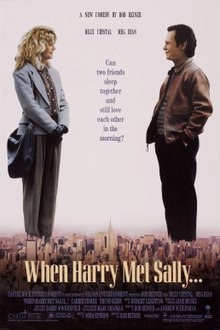
Another example of this would be in the film 'When Harry Met Sally' where Harry is represented in the same way as Gary, confused and just doesn't understand women.


Monday, 1 April 2013

Gender Representations in Romantic Comedies: Females

Romantic comedies are a much loved genre by both male and female audiences. In this post I will discuss how women are represented in this genre and how I am going to represent women in my opening scene. In many romantic comedies women hold a key role and are commonly the protagonist, the usual target audience of the romantic comedy is a female one. Common elements and plot-points of the romantic comedy genre include break-ups, love at first sight and two friends going that one step further and turning their friendship into a relationship. In rom-coms women are often stereotyped as being unlucky in love and unable to find "Mr. Right". A good example of this recurring character trope would be Bridget Jones in the film 'Bridget Jones diary'. 


     In this film we see that protagonist Bridget Jones is an average woman struggling against her age, her weight, her job, her non-existent love-life and her many other imperfections.  Bridget yearns for commitment and love and like in other rom-com female protagonists, is often getting her heart broken and can't find the right man. This is one of the most common elements found in  romantic comedies with most of them following a similar story structure.

    A different representation is the dominant female protagonist. These characters will typically be breaking male characters hearts or have men falling head over heels for them. An example of this would be Sarah Marshall 'Forgetting Sarah Marshall' . In this movie the character Sarah Marshall dumps her loving boyfriend after five years and leaves him alone to wallow in his sadness and finds a new man straight away. This shows that in some films females can be represented as the villain and is not always the one looking for love.


In my opening scene of 'House of Heartbreaks' the women are going to come across as the dominant female. All of Kevin's girlfriends are leaving him to wallow in sadness like in 'Forgetting Sarah Marshall', for being bad boyfriend. Although they are leaving him for a fair enough reason, we will be trying to make the audience feel slightly sorry for him by portraying the women as if they have no hearts and who do not care about hurting people's feelings, making it look as though they are in the wrong creating sympathy for Kevin.


Location and Setting

Here I have taken pictures of the location and setting of our opening scene.