With romantic comedies the fan base doesn't largely consist of males, but mainly of many females, like I have talked about in my previous post 'Gender Representations In Romantic Comedies: Females'. In this post I will focus on the representations of male characters in rom-coms and how the male protagonist 'Kevin' will be represented in my opening scene of 'House Of Heartbreaks'. In my opening scene, I will be displaying Kevin as a stereotypical man who is lazy and doesn't do much to help around the house and just doesn't understand women. In most romantic comedies males are represented as being in their own world and just really don't understand women. A prime example of this would be the film 'The Break Up'.
In this film it shows two couples going through a break-up and I also looked at a scene where the female protagonist breaks the relationship up, saying 'I'm done' to the male protagonist. In this scene they are arguing over Gary not being romantic, buying Brooke flowers even though Brooke has said before that she hates flowers and thinks they are stupid. Gary doesn't understand what he's done wrong because he knows she doesn't like flowers and doesn't want to waste money on something she wont like. You can tell that he just really doesn't get that even though she has said she doesn't like flowers, all she wants is to be treated to a few romantic surprises now and again. This is a perfect example of how we want to represent Kevin. He tries his best but he just cant understand what a girl wants.
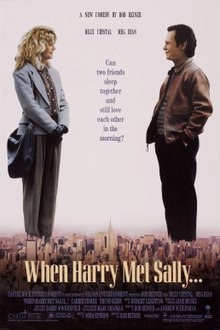
Another example of this would be in the film 'When Harry Met Sally' where Harry is represented in the same way as Gary, confused and just doesn't understand women.
Romantic comedies are a much loved genre by both male and female audiences. In this post I will discuss how women are represented in this genre and how I am going to represent women in my opening scene. In many romantic comedies women hold a key role and are commonly the protagonist, the usual target audience of the romantic comedy is a female one. Common elements and plot-points of the romantic comedy genre include break-ups, love at first sight and two friends going that one step further and turning their friendship into a relationship. In rom-coms women are often stereotyped as being unlucky in love and unable to find "Mr. Right". A good example of this recurring character trope would be Bridget Jones in the film 'Bridget Jones diary'.
In this film we see that protagonist Bridget Jones is an average woman struggling against her age, her weight, her job, her non-existent love-life and her many other imperfections. Bridget yearns for commitment and love and like in other rom-com female protagonists, is often getting her heart broken and can't find the right man. This is one of the most common elements found in romantic comedies with most of them following a similar story structure.
A different representation is the dominant female protagonist. These characters will typically be breaking male characters hearts or have men falling head over heels for them. An example of this would be Sarah Marshall 'Forgetting Sarah Marshall' . In this movie the character Sarah Marshall dumps her loving boyfriend after five years and leaves him alone to wallow in his sadness and finds a new man straight away. This shows that in some films females can be represented as the villain and is not always the one looking for love.
In my opening scene of 'House of Heartbreaks' the women are going to come across as the dominant female. All of Kevin's girlfriends are leaving him to wallow in sadness like in 'Forgetting Sarah Marshall', for being bad boyfriend. Although they are leaving him for a fair enough reason, we will be trying to make the audience feel slightly sorry for him by portraying the women as if they have no hearts and who do not care about hurting people's feelings, making it look as though they are in the wrong creating sympathy for Kevin.
Setting
House: The opening scene of our film will be set in a house on Claremont Road in Hextable. I have chosen to set the scene in a house because this is where the protagonist Kevin would spend most of his time seeing as one of his main characteristics is laziness and he lacks motivation to get out of the house unless it involves drinking down the pub with his friends. It is also the place where all of his girlfriends spend most of their day cleaning up after him. The reason I chose to set our opening scene in this location was because romantic comedies I have studied usually involve a domestic setting such as The Break Up and Spaced, which are two of the films and television shows that influenced the story. The house is located in a quiet village which can signify that the relationship is 'dead end' and 'boring' and will go no further.
Props
Alcohol: In my opening scene I will be placing some empty beer and wine bottles around the set of the bedroom. This will symbolize that Kevin doesn't get out of his bedroom much and never tidies up after himself which is one of the reasons for his girlfriends leaving him. There will also be a a TV on in the background with a PlayStation 3 attached to it with the hit game FIFA 13 playing. I have included this because stereotypically this is a game that takes up a lot of boys time and in this case it seems that he has spent the majority of the relationship playing on his PlayStation and not spending time with his girlfriend.
Another prop we have included is a poster of the hit 1985 film 'The Goonies'.
'The Goonies' is the story of 7 teenagers who go on an adventure in search of treasure pursued by three gangsters. I have placed this in the frame of the shot because it is a children's film and could signify that Kevin is still a teenager and hasn't grown up yet. I have also placed a a Batman canvas on the wall on the other side away from 'The Goonies' poster.
I have decided to include this because 'Batman' and similar superheroes are usually associated with again, children and teenagers. This will show that Kevin has not grown up and still acts like a teenager. Another prop that I will be including will be clothes. I have placed them in the first setting of the bedroom, on the bed. The first girlfriend will be putting all of her clothes in her bag because she has had enough of Kevin and his child-like behaviour and is moving out.
Costume and Make-up
Throughout the scene Kevin will be wearing something different each time we see a new girlfriend to represent the change in time. With the first girlfriend, Kevin will be wearing skinny light blue jeans with a black American Eagle top, but it will then change when we see the next girlfriend on the screen. With this one he will be wearing a black and white striped top with shorts. Wearing the shorts will signify the change in time and seasons, suggesting that it could possibly be summer. Also, a black and white striped tee-shirt can represent that he is rather child like seeing as a lot of the younger generation wear stripy clothing and it creates a sense of mischief. And finally in the last scene Kevin is wearing skinny acid wash jeans with a Hooters top. This shows that he likes going to seedy places and can also represent that he is not quite committed seeing as 'Hooters' is a well known restaurant in America for attracting lustful men because the waitresses tend to be attractive and wear skimpy clothing. This shows that he may have his eyes on other girls instead of his current girlfriend. The girls on the other hand will be wearing more bright colours. The first girl will be wearing a blue dress to represent that she has quite a cold personality. This will create a likeability for the protagonist Kevin and will make the audience sympathise with him. The next two girls are wearing all white colours which symbolises innocence and that they are not in the wrong for breaking up with Kevin.
Body language and facial expressions
To signify particular emotions I will be using certain body language and facial expressions.
I will have Kevin shrugging and holding his arms out to display that he is acting innocent with most of the girls as if he's not done anything wrong. His facial expressions will also make the audience think that he is trying to get out of a bad situation. For the girls, I will have the first girl showing signs of anger on her face whilst throwing all of her belongings in her bag aggressively to display the fact that she's just had enough. With the next two girls I will have them storming away from Kevin as if they are running from him trying to escape and Kevin is chasing after something like he is about to lose like a prized possession and is trying to grab it before it is out of his life forever.
Lighting
With the lighting I will create low key lighting when the camera is on Kevin to make a dull and depressing atmosphere around him. With the girls I will create a more high key lighting effect to make the atmosphere brighter to create a sense of freedom and light as they are leaving Kevin.
This is a scene from Notting Hill which depicts a long passage of time (a year) passing in a matter of minutes. This relates to the opening scene of my film which presents the idea that the protagonist Kevin can never change his lazy, "bad-boyfriend" habits even if given a long period of time. My scene tricks the audience into thinking they are watching one argument between Kevin and his girlfriend, however as the scene unfolds we realize that it is the same argument happening on numerous occasions between three different girlfriends over the years.
In this particular scene in Notting Hill we see Hugh Grant's character walking through a market after breaking it off with a love interest. The passage of time passing is cleverly depicted by the changing seasons and as Hugh Grant's character walks the length of the market in a minute and a half we see summer turn to autumn to winter to spring before finally back to summer again, telling the audience that a year has passed. These transitions are smoothly executed; for example the camera moves past a white van and suddenly we are in winter with snow falling, covering the street and the screen.
When he begins walking we know that it is summer from the high key lighting as shown in the picture above. Another way of showing the audience that we are in summer is by the fruit stall. The sign says 'Ripe Peaches' so this tells us that they have been freshly picked and peaches are, most commonly, ripe for the picking during late spring/early summer time.
As he continues his walk it begins to rain and then a flurry of leaves blow past him. This then signifies the transition from summer to autumn.
As he walks on, he passes a white van. When he passes the white van snow suddenly appears all around the scene and we understand that it is now winter. Having the protagonist walk past a white van made the transition a lot smoother. Because the van is white, it blends in cleverly with the snow.
While we are in spring the lighting is slightly dull, making the setting seem cloudy.
The tracking shot shows a man walking in front of the camera.
The light brightens as we go from spring to summer, emphasized by bright
blooming flowers.
We also see the transition from spring to summer in the following techniques:
The flowers are displayed on sale to illustrate bright colours which you find on blossoming flowers in the summer months. You can almost see the glow from the bright blooming flowers reflect on the protagonist's face in the first image. The majority of the flowers are yellow like the sun to show it is summer and how hot it is. In the second image he has taken his jacket off due to the possible fact that it is too hot in this season. Also he seems to be happy whereas he didn't seem particularly happy in the beginning of the scene when he approached autumn. Overall I feel that the scenes above are trying to show that people are generally happier in the hotter months of the year and this is portrayed by Hugh Grant's character in the clip.
If we go back to the beginning there are many different ways to present the seasons changing. In the fifth second we see a pregnant woman looking at items on the market stall. If we cut to 1:29 minutes we see the same woman, this time holding a baby which we assume is hers. This is a clever way to show that at least 9 months has passed.
Another indication can be seen in the eleventh second when Hugh Grants character's sister is standing, cuddled up to her boyfriend. By 1:20 minutes we see her once again, this time crying with her boyfriend walking away from her. He has broken up with her in the space of a year. This shows the passage of time, cleverly highlighting the fact that a lot can change in the space of a year.
Some of the props and costumes that are used in this scene are the following:
We see a Christmas tree and a Christmas stall selling items for this specific season. There is also a man dressed up as Father Christmas to highlight the winter weeks leading up to Christmas. They are all wearing warm cloths such as big puffy coats for the cold winter season.
We see here that the protagonist has put on his jacket to shelter himself from the bitterness of autumn and we also see umbrellas in the background sheltering people from the rain.
The song which is playing over the scene is the 1971 song 'Aint No Sunshine' by Bill Withers. I feel that this song has been used because the protagonist's love interest has left him making him upset and depressed. Having the song playing over this scene re-enforces the point that without her in his life he is miserable.
I believe that Richard Curtis has presented the passing of time in an intelligent and original way. I would take into consideration a lot of the techniques and stylistic choices he has used such as the costumes and the pacing of the scene. The majority of the scene would be almost impossible for me to make unless I had a large budget. The way he has created the scene without any editing is smartly executed and would be almost impossible for an AS student to produce without the proper equipment and funding.
My group and I talked about using a tracking shot in our opening scene which would depict Kevin walking from room to room and in each room a different girl appears. The girls would serve the same purpose as the seasons in this scene from Notting Hill. Just like the seasons, the girls would be changing as he moved from room to room, highlighting a period of time passing. The problem with this is, in order for it to be effective and smooth like it is presented in this scene we would need expensive equipment like camera tracks to get a first-class dolly shot and would also probably have to knock some holes in the walls of my parent's house! Strangely, they are not okay with this. The ideas and elements that I would take from this scene would be the tracking shot, but sadly I don't think we will be able to execute this in our opening scene.